Agent Rank breakdown
- Autonomy
- 9
- Capabilities
- 8
- Integrations
- 6
- Pricing
- 4
- Polish
- 7
- Verifiability
- 6
Auto-computed from autonomy, capabilities, integrations, pricing, maturity and editorial verification. Updated every deploy. How is this computed?
Capabilities
- Tool use
- Memory
- RAG
- Multi-agent
Integrations
- CRM
- Salesforce
- Commerce
- Stripe
- Other
- PlaidDatadog
Pricing tiers
- +Fraud + AML core agents
- +4 integrations
- +Standard SLA
- +Full agent suite
- +Unlimited integrations
- +Custom rules engine
- +EU/US data residency
- +On-prem option
- +Dedicated CS
Pros & cons
- +$145M total (a16z) — top of the agentic financial-crime category
- +Consolidates 11 fraud/KYC/AML vendors into one platform
- +Auto-reviews 40% of monthly applications — major cost reduction
- −Enterprise focus — not priced for SMB fintechs
- −Regulatory complexity requires legal review per deployment
- −Best ROI requires existing high-volume transaction flow
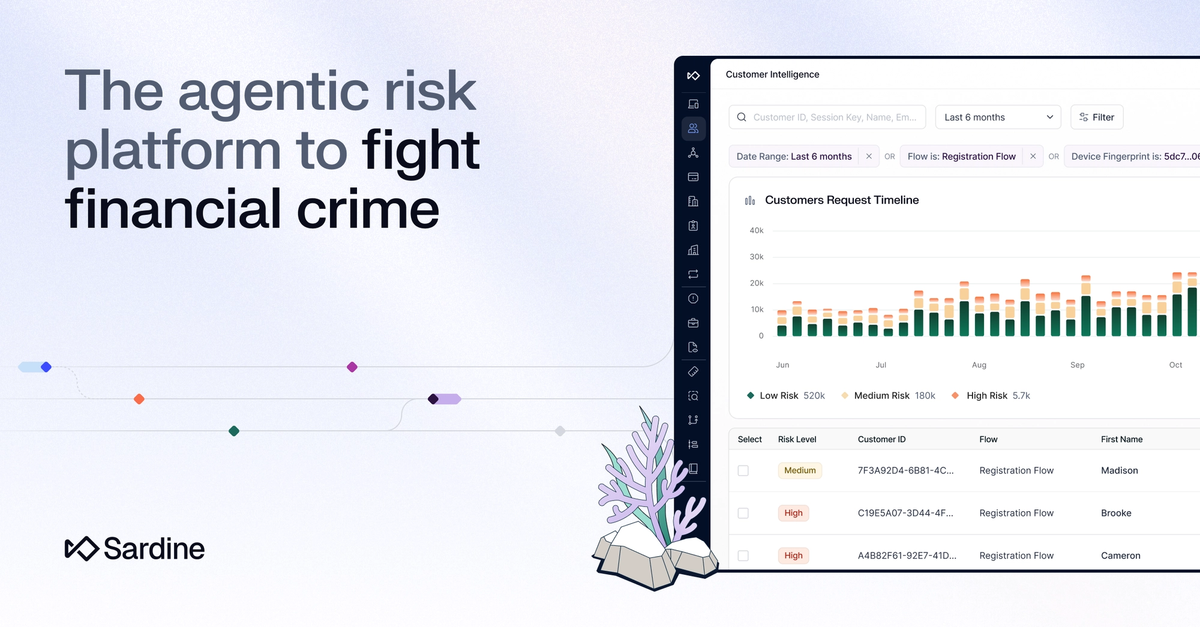
Agentic financial-crime ops — consolidates 11 fraud/KYC vendors, auto-reviews 40% of applications. Start with the subscription tier.
Frequently asked questions
What is Sardine?+
Sardine is an agentic financial-crime operations platform — replaces 11 separate fraud/KYC/AML vendors with one AI-native stack. $145M raised; auto-reviews 40% of monthly applications.
Sardine vs Sift?+
Sift is rule-based fraud detection; Sardine is agent-first (autonomously investigates and resolves cases). Sift wins on raw rule speed; Sardine wins on case throughput and analyst productivity.
Is Sardine compliant for US banks?+
Yes — Sardine is built to support BSA/AML compliance for US banks and money service businesses. SOC 2 Type II certified; supports state-level reporting requirements.
User reviews
Write a review →Be the first to review. We verify every reviewer by email.