Décomposition de l'Agent Rank
- Autonomie
- 9
- Capacités
- 10
- Intégrations
- 6
- Tarification
- 8
- Maturité
- 9
- Vérifiabilité
- 10
Calculé automatiquement à partir de l'autonomie, des capacités, des intégrations, de la tarification, de la maturité et de la vérification éditoriale. Mis à jour à chaque déploiement. Comment est-ce calculé ?
Capacités
- Browser Use
- Tool Use
- Exécution de code
- Memory
- RAG
Intégrations
- Gmail
- Docs / wiki
- Notion
- Storage
- Google Drive
Niveaux de tarification
- +100 crédits par jour
- +Modèles standard
- +Browser Use + Tool Use
- +Crédits illimités
- +Modèles premium
- +File d'attente prioritaire
- +Support prioritaire
- +5 postes
- +Espaces de travail partagés
- +Contrôles administrateur
Our take on Manus
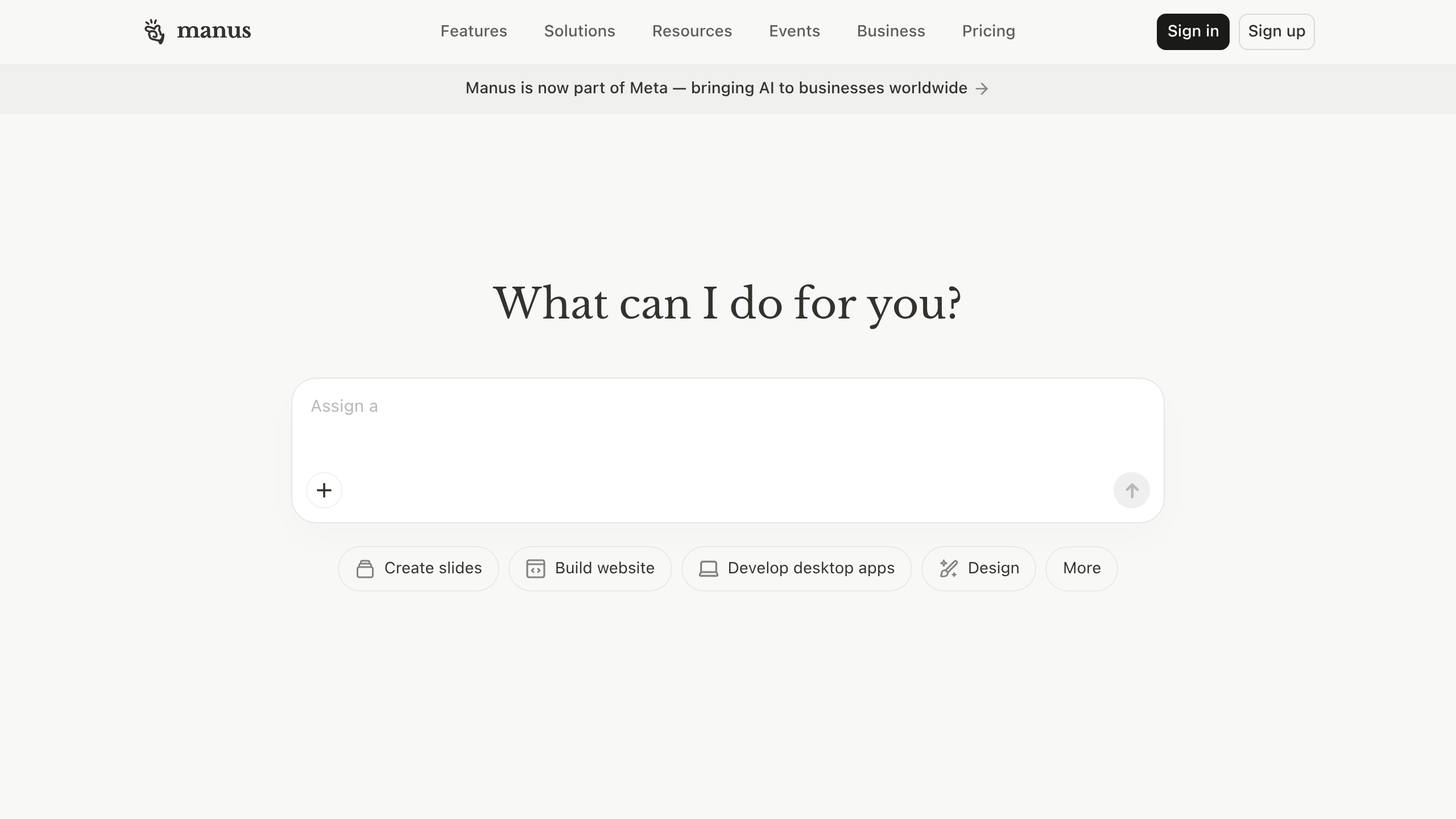
Manus is the closest thing to "a generalist AI employee" we've tested. One prompt in, a finished deliverable out — research reports, spreadsheets, slide decks, working web apps. Wildly capable; occasionally wildly off the rails.
- +Single prompt produces complete, formatted deliverables — not just chat replies
- +Genuine multi-step planning that runs for 10-30 minutes per task
- +Excellent at research-heavy work that ends in a structured artifact
- +File system + browser + code execution all integrated cleanly
- −Quality varies more than narrowly-scoped agents — best to budget rework time
- −Premium tier needed for the most capable runs; free tier is rate-limited
- −Confidence in output sometimes outpaces accuracy — verify everything
- −Cannot easily intervene mid-run; you wait until it finishes
- ·Research briefs, market analysis, competitor teardowns
- ·Building prototype web apps from a single specification
- ·Generating polished slide decks or reports for internal review
- ·Compliance-sensitive work — Manus runs in its own cloud, your data goes through it
- ·Long-form research with citations — double-check sources before sharing
What "general purpose" actually means
Most agents specialize: code, sales, support. Manus is positioned as the generalist — you describe an outcome ("build me a competitive analysis of the top 5 employee engagement tools, include a comparison matrix, and produce a 3-slide summary deck"), and Manus orchestrates browser research, document drafting, code execution, and file output to produce the artifact.
In our tests this works surprisingly well. The agent will browse, take notes, generate a structured comparison, render it to PDF or PPTX, and hand you a download link. End-to-end, without you steering each step.
The workflow
The interaction model is unusual:
- You write a single, detailed prompt.
- Manus generates a plan (you can review or edit it).
- It executes — often for 10 to 40 minutes.
- You receive a folder of deliverables: research notes, the final document, any intermediate code or data.
You don't chat with it mid-run. This is a deliberate design choice — by removing human-in-the-loop interruptions, Manus can plan longer horizons. The tradeoff is that when it goes off-rails, you pay for the full run before you can correct it.
Where it shines
Three task families consistently produce strong output:
-
Research-to-artifact pipelines. "Summarize the regulatory landscape for crypto in the EU as of May 2025" → 4,000 words with citations, a comparison table, and a one-page executive summary. Comparable to a junior analyst's first draft.
-
Prototype web apps. "Build a Next.js app that lets users upload a CSV and generates a chart from it" → working repo, deployable, with a README.
-
Slide decks from outlines. Hand it a bullet-point outline; receive a finished PowerPoint with consistent styling and basic data visualizations.
Where it stumbles
- Tasks requiring real-time iteration. If you'd normally say "wait, change that third paragraph," Manus's batch model fights you.
- Citation accuracy. Like all browse-and-summarize agents, Manus occasionally conflates sources or invents specifics. Verify every quote, every stat.
- Highly creative work. It will produce competent writing, not great writing.
Pricing
Free tier is rate-limited (a few runs per day, capped duration). The $19/mo Standard
plan unlocks longer runs and parallelism. The Pro plan ($39/mo) gives priority queue
and the best model access. With our coupon AGENTS20, the first month is 20% off.
Bottom line
Manus is the agent we'd hand the brief that says "I need this whole thing done by tomorrow and I don't care how." It's not the right tool for iterative work. Use it for batch deliverables and you'll be impressed; use it for collaboration and you'll be frustrated.
Agent polyvalent qui transforme une simple invite en livrable finalisé. Commencez avec le tier freemium.
Questions fréquentes
Qu'est-ce que Manus et que fait-il ?+
Manus est un agent IA polyvalent entièrement autonome. Vous lui assignez un objectif — analyser un marché, construire un tableur, rédiger un rapport, exécuter un Workflow web en plusieurs étapes — et il planifie, exécute et livre. Premier du benchmark GAIA début 2026 avec 76 % de précision. Abonnement Starter à 39 $/mois.
Manus IA vaut-il 39 $/mois ?+
Pour les utilisateurs réalisant 5 tâches autonomes multi-étapes ou plus par semaine, oui. Le coût par tâche est nettement inférieur à celui de ChatGPT Pro (200 $/mois) pour une autonomie équivalente. Pour les utilisateurs occasionnels, ChatGPT Plus ou Perplexity Pro à 20 $/mois couvrent la plupart des besoins à moindre coût.
Manus vs ChatGPT Agent — lequel est le meilleur ?+
Manus l'emporte sur les tâches autonomes de plusieurs heures, les benchmarks de type GAIA et le coût. ChatGPT Agent l'emporte sur la profondeur des intégrations (Custom GPTs, Code Interpreter, Voice), l'écosystème et le raffinement grand public. Pour un travail autonome "fixez l'objectif et laissez tourner", choisissez Manus. Pour un assistant quotidien avec voix et capacités étendues, optez pour ChatGPT.
Reviews utilisateurs
Écrire une review →Be the first to review. We verify every reviewer by email.