

AI SDR that converts inbound website visitors into qualified pipeline 24/7.
Tool useMemoryRAG

8 alternatives to Clay, ranked by category, capabilities and integration overlap. Click any card to see a side-by-side comparison.
Three signals usually push buyers to look beyond Clay: pricing has outgrown the use case, a critical integration is missing, or the autonomy model doesn't match the workload. The shortlist below ranks alternatives by overlap on capability, integrations and category fit, so the closest practical substitutes surface first.
If the only reason to consider a switch is cost, start with the free-tier or open-source options. If the reason is capability, sort by similarity score and check the integration matrix on each agent page. If the reason is autonomy mismatch, drop a level (autonomous → semi-autonomous → copilot) and re-evaluate.
AI SDR that converts inbound website visitors into qualified pipeline 24/7.
AI digital workers for sales — Alice (SDR), Mike (SDR), and Jordan (CSM) handle full-cycle outbound.
AI sales agent for outbound — generates personalized sequences, manages cadences, and books meetings.
Account research agents that prep your AEs before every call.
Three-agent AI SDR suite (Signal, Research, Sequence) inside one outbound platform.
Sales intelligence AI — 275M contact database plus AI sequences, dialer, and deal management.
AI sales execution platform — engagement sequences, deal forecasting, and conversation intelligence.
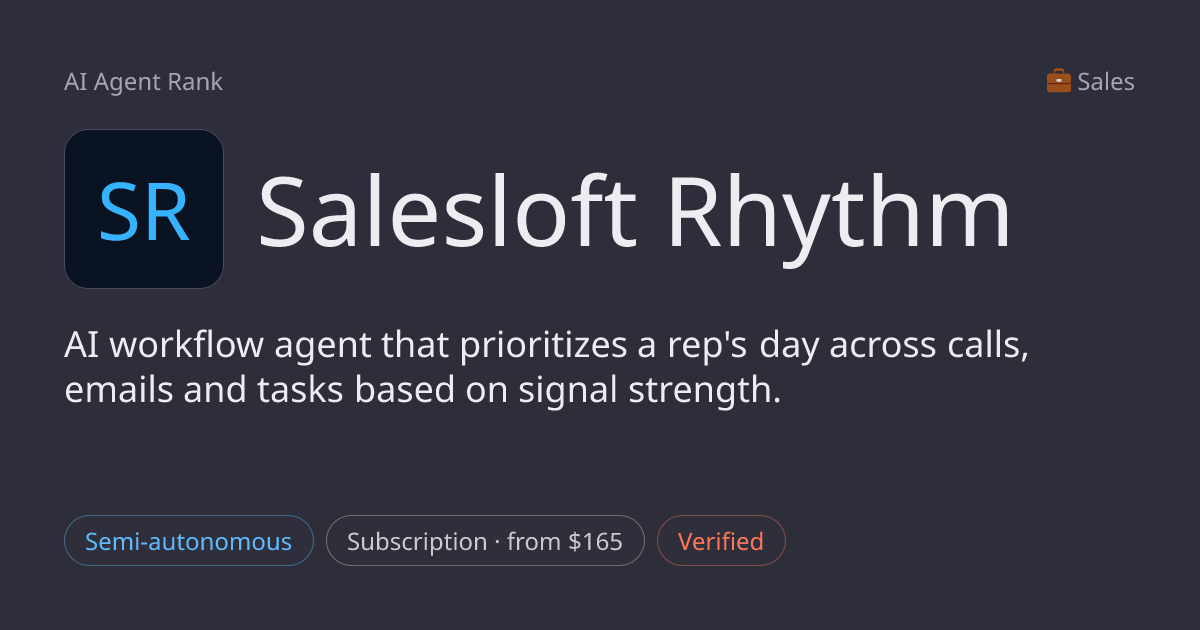
AI workflow agent that prioritizes a rep's day across calls, emails and tasks based on signal strength.
Sort the shortlist above by price. Open-source options carry $0 license cost but require self-hosting (or bring-your-own model API spend). Free SaaS tiers typically rate-limit features that Clay ships unlimited — verify the tier matches your daily volume before switching.
Yes — every alternative on this page with an "Open source" or "Free" pricing badge ships a usable free tier or full open-source license. Read the per-agent pricing detail before committing; "free" in this category usually means "free for prototyping" rather than "free in production at scale".
Depends on integration depth. A swap inside the same category (e.g. code agent → code agent) on the same IDE/CRM/stack typically takes 1-3 hours: install the alternative, point it at the same data sources, run a parallel workflow for a week. Cross-category swaps (e.g. semi-autonomous → autonomous) need workflow redesign — plan 1-2 weeks.
Sort the shortlist by integration footprint — each agent card surfaces its integration count. The widest-footprint alternatives target enterprise stacks (Salesforce, Slack, GitHub, Microsoft 365) first; niche or open-source alternatives often ship fewer native integrations but more extension points.
Yes — Agent Rank is the editorial composite across six dimensions (autonomy fit, capabilities, integrations, pricing value, polish, verifiability). For a like-for-like swap, prefer an alternative with similar or higher Agent Rank in the same category. See /methodology for the full scoring rubric.